

Build or buy? Inside a football operating system.
AI makes software easier to start. Football makes it hard to finish.
Jonathan Hazut, Co-founder and Chief Technology Officer
A Serie A club was developing its own platform when another club hired its lead developer. In a conversation with us, the club described the situation this way:
“We have the car, but right now we’re missing the driver. This is a world where you have to keep updating and work on the details every day, because things change constantly. A finished, perfect product doesn’t exist.”
A LaLiga club put the other side of the dilemma just as clearly:
“If I buy something from outside, it has to be very differentiating. Something I can’t develop, or something I can develop but don’t have the capacity to, either to build or to maintain.”
Everyone is building now
AI has turned build or buy into the question of the moment. Tools such as Claude and ChatGPT now write code, test ideas and help maintain software. Companies in every industry are asking whether the systems they license could be built in-house within months.
For a company whose product is software, building can be a sound bet. It has engineering teams, a long-term roadmap and budgets planned years ahead. Building and maintaining systems is what it does.
Football clubs are now asking the same question. From inside a club, the answer looks very different.
A club is built to win matches
A club’s product is the result at the weekend. Its best people are hired to play, coach, scout, analyze and prepare, not to run a software company.
Budgets move with results, transfer windows, qualification for continental competitions and, for many clubs, the threat of relegation. Staff often change when the manager or sporting director changes. Salaries for non-playing staff rarely compete with what technology companies pay the same engineers. And the calendar never pauses: the next match is often three to five days away.
None of this stops a club from writing good software. Clubs also have something no outside vendor starts with: the clearest understanding of what they actually need.
That understanding is what Marquee was built on. From the start, we developed the product through a feedback loop with leading practitioners and clubs in world football, so it answers the questions they face every week. The difference is that turning those questions into a working platform is our full-time job.
Our product spans the entire sporting side of a football club, from internal analysis and squad management through player recruitment and all the way to match preparation. Pre-match, post-match and set-piece reports are part of that scope, with more capabilities to come.
Where the idea to build comes from
Most internal projects start with a real problem: too much data and too little time. Data arrives from several providers, each with its own identifiers, definitions and update schedule. Clubs pay for all of it, yet most use only 4 to 15 percent, because nobody has the hours to turn the rest into answers. Meanwhile, the same small department has to support recruitment, squad management, opposition analysis, post-match review and set-piece work, often for more than one team.
There is never enough time to do everything the club needs. A system that does more of that work for them becomes an attractive idea.
This is the tension at the center of the decision. A club considers building because its time and people are already stretched. Building a platform, and then maintaining it for years, would claim a significant share of that same time and those same people. It is also a financial bet on a product that may turn out well, or may not. The rest of this article shows what that commitment involves.
Start with the football question
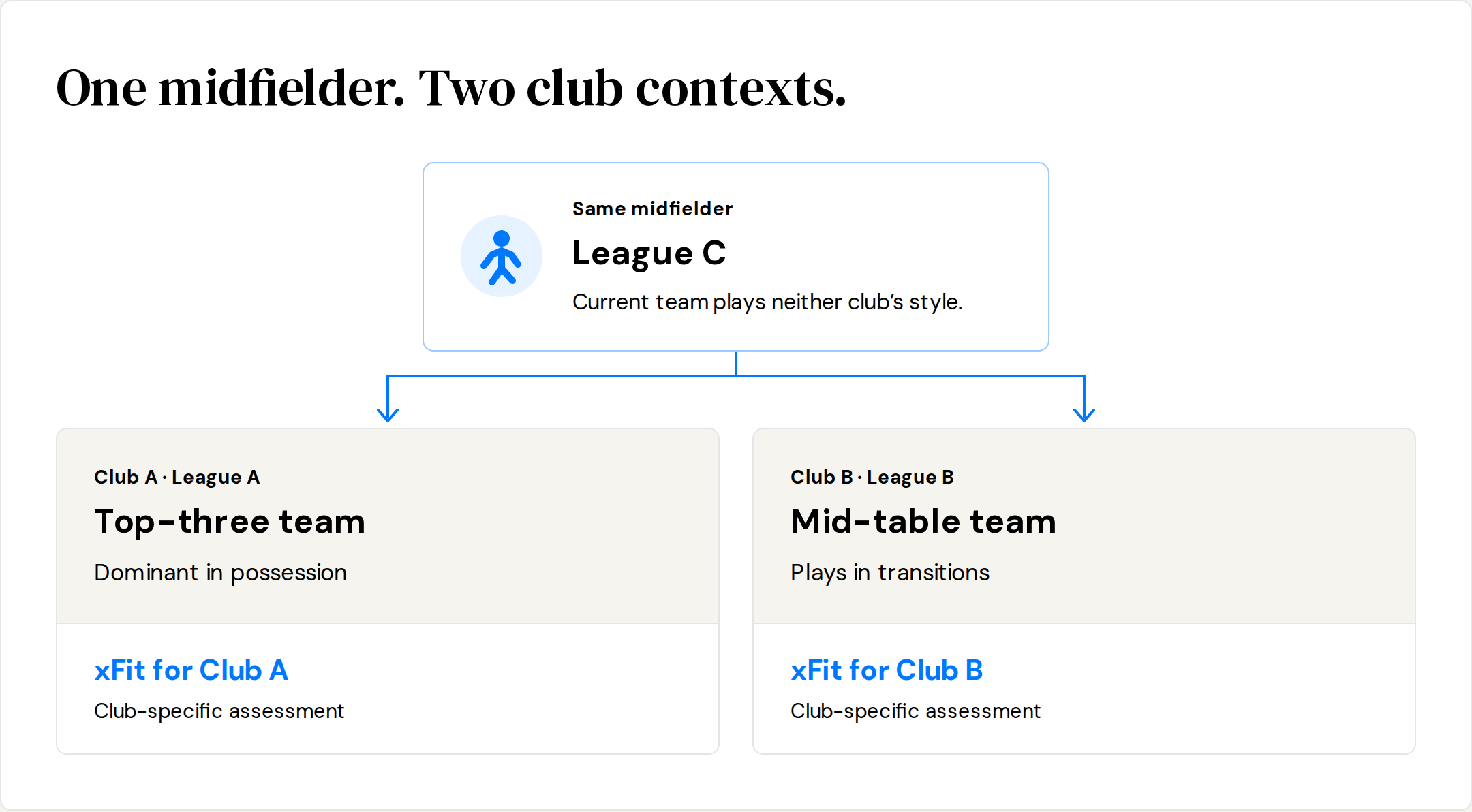
Two clubs are considering the same midfielder. One is a dominant, possession-based team in its league’s top three. The other sits mid-table in a different league and plays through transitions. The player is in a third league, at a team that plays neither way.
His current numbers describe what he does there. Each club needs to know whether those qualities answer its own needs, alongside its existing players and style. That is where xFit, our one-to-ten Expected Club Fit score, comes in. Marquee also assesses potential partnerships between players who have never shared a pitch.
To get there, the analysis has to separate what reflects individual quality, what comes from team strength and what reflects a playing choice. A player may look better because of the teammates around him. A team that rarely plays long passes may be choosing not to, rather than unable to. Marquee makes those distinctions automatically and clears out the noise before the club commits its limited video-analysis and live-scouting time. Marquee does not make the call. It narrows the field, and the judgment stays with the club. Our Squad Fit article explains how the squad’s needs shape that assessment.
From a brief, Marquee produces a shortlist of relevant players in seconds. From a flagged player, it generates a full scout report in under a minute.
Recruitment is one workflow. The same club context drives squad management and match preparation.
Before any shortlist exists, Marquee analyzes what the squad already produces, how it plays and what is missing. That matters because recruitment meetings bring different priorities into the same room. The owner wants a headline attacking signing. A scout backs the talent he has followed for months. The coach, under pressure for results, wants a defender. An objective evidence base lets the brief start from the team’s needs.
On the match side, the questions change every few days. How will the next opponent line up? Where does its threat come from, which match-ups should we target and how does it defend set pieces? What did our last match actually show? Pre-match, post-match and set-piece reports answer those questions in the club’s own context.
Marq, our AI agent, helps staff explore all of this in football language. A sporting director clarifies a role, adds a constraint or challenges an interpretation, and Marq refines the context behind the next interaction. Every insight is traceable to its source, and every model output carries a confidence level, so staff can examine the evidence behind any assessment and challenge it.
Building this internally means building every one of these workflows, and the reasoning that connects them.
Beneath the answer
Marquee runs 25 proprietary AI and machine-learning models in production. They are trained, validated and already supporting clubs around the world. Together they read the game, understand the player, the environment and the match, and support the final decision. Most use neural networks, including transformers and graph neural networks.
The feedback loop with practitioners shapes the technical choices: representing players in context, evaluating relationships between them and turning connected evidence into usable analysis.
Our coverage spans 90 competitions, and we train on a cross-provider database drawing from eight data vendors. Coverage depth varies by competition and season. Many clubs buy 20 to 50 competitions from one or two providers, because broader access is expensive. That puts our training foundation on a different scale before the first experiment starts.
Cross-provider training requires more than pooling rows. Records must refer to the same player and the same match, and similarly named metrics must keep their actual meaning. Otherwise, a larger dataset teaches a model the wrong distinction.
Another challenge is dependency. Change a learned player representation and the assessments built on it can change, even when their own code has not. An improvement in one model has to earn its place across the connected system.
Evaluation is where much of the research effort goes. We test on seasons the models have not seen, examine the effects of team strength and playing style, and run ablation studies, removing components to understand what each contributes. For a question like club fit, deciding what counts as a good answer is itself part of the research.
Evaluation does not stop at release. New data, changed assumptions and updates to connected models keep raising questions to test, and a strong training result has to survive all of them before it reaches a club.
Training means repeated experiments, version comparisons and runs that never reach production. Compute costs money, training takes time, and every output needs review by researchers, engineers and football specialists. Those cycles have already run behind the models a club can use today, and they continue as we improve them.
To build this internally, a club would need to license the data, hire the research team and fund every one of those cycles itself.
Nothing stays still
The January transfer window changes squads, and the data has to keep up. One problem we had to solve is keeping a player’s history connected when a transfer changes his league, his provider identifiers and the coverage available. A change in what can be observed must not be mistaken for a change in the player.
The suppliers move too. Providers update their glossaries. New metrics arrive every month. A club may switch providers overnight because the next annual fee no longer suits it. Each change reaches well beyond a connector: field meanings, identity matching and every analysis using that information need attention.
The club moves as well. A new manager, sporting director, board or set of targets can change recruitment strategy in a week. The club’s configuration has to move with it.
Marquee’s data-agnostic foundation lets us absorb these changes quickly across the product. Our multi-tenant architecture combines a shared engineering foundation with separate club environments, so each club’s data, playing approach, role definitions and constraints remain distinct. We use Kubernetes to manage the services behind the platform, with repeatable deployments that preserve club configuration as models and software change. Capacity planning, monitoring, upgrades and incident response are part of our team’s daily work.
For an internal build, this is the part that rarely appears in the original plan. It lasts as long as the system does.
The fixture list sets the deadline
The short window between matches has to hold recovery, preparation, coaching and decisions.
Marquee’s match reports are ready the moment the providers’ data arrives. A post-match report is available at the click of a button, and pre-match and set-piece analysis feed the preparation that follows. Analysts do not spend the window digesting raw data. They spend it applying their expertise, making decisions and working on the questions the reports raise.
We can have a club live in 48 hours. Building a platform of comparable breadth internally can take a season or more. The difference is when the football staff can start using it.
The fixture list has never been especially patient with a development backlog.
Protect the thinking behind the decision
A club’s shortlist, tactical principles and recruitment logic are competitive assets. Using AI and off-the-shelf large language models (LLMs) without exposing that knowledge is a serious engineering responsibility. Licensed football data also comes with strict contractual limits on its use in public models.
Meanwhile, attackers now use AI to accelerate their own work. Security has to keep pace with the software, the integrations and the threats around them.
Marquee has completed a SOC 2 Type II examination, in which an independent auditor tested our controls and how they operated over time. Tenant isolation separates club environments, and encrypted storage protects data at rest. Access reviews, patching and audit logs are routine parts of running the service.
What we learn from working with clubs around the world improves the product for every client: which explanations need to be clearer, which questions recur and where a workflow needs less friction. Each club’s game model, methods and data stay in its own environment. Club data remains the club’s, and is not used to train models for other organizations.
Any technical evaluation, internal or external, should establish exactly which information can reach each model provider, and under what processing, retention and training terms. Building internally means taking responsibility for those boundaries and the security work that maintains them.
It takes a team
Backed by investors who know the game and share our vision, including Axel Springer and APEX, we invest millions of dollars a year in the product: research, engineering, training compute, data and the specialist work that turns analysis into something clubs can use.
A comparable internal effort needs software engineers, data scientists, DevOps specialists and a chief information security officer (CISO) or equivalent security leadership. At a club, those people also face the football department’s daily demands. Research competes with the report needed this afternoon.
Continuity matters as much as hiring. When a system depends on one or two people, a job offer elsewhere or a departure alongside a manager or sporting director can stall it. The club still owns the code. It may have lost the only person who knows why it works. In the Serie A club’s words, the car is there, but the driver has gone.
The real cost of building
Go back to where the idea started. The club considered building because its people had too little time and too many demands.
Everything above would draw on those same people. Months of their time would go into scoping, hiring, licensing data, training and testing models, and securing the system. Then they would need to maintain it for as long as it runs, through every glossary update, provider switch and change of manager. Every hour spent on the pipeline is an hour not spent on the next opponent or the next signing.
The return, if it comes, arrives seasons later, and only if the people who built it are still at the club. For most clubs, that makes an internal platform a negative-return investment of exactly the resources it was meant to free up.
Build on top, not instead
That does not mean throwing away work a club has already done. Because Marquee is data agnostic, we can bring the models that already work for a club into its Marquee environment and build on top of them.
Internal models, scout grades, reports and football knowledge can sit alongside the platform’s existing capabilities. The club’s people spend less time maintaining infrastructure and more time on the questions that give them an edge.
The club puts trained models, connected data and ongoing platform engineering to work now, then focuses its own development on what is distinctive about its football. As we validate and release improvements, that foundation keeps developing.
Build or buy? Compare the continuing work.
Compare an internal platform of similar scope with the capability already operating at Marquee.
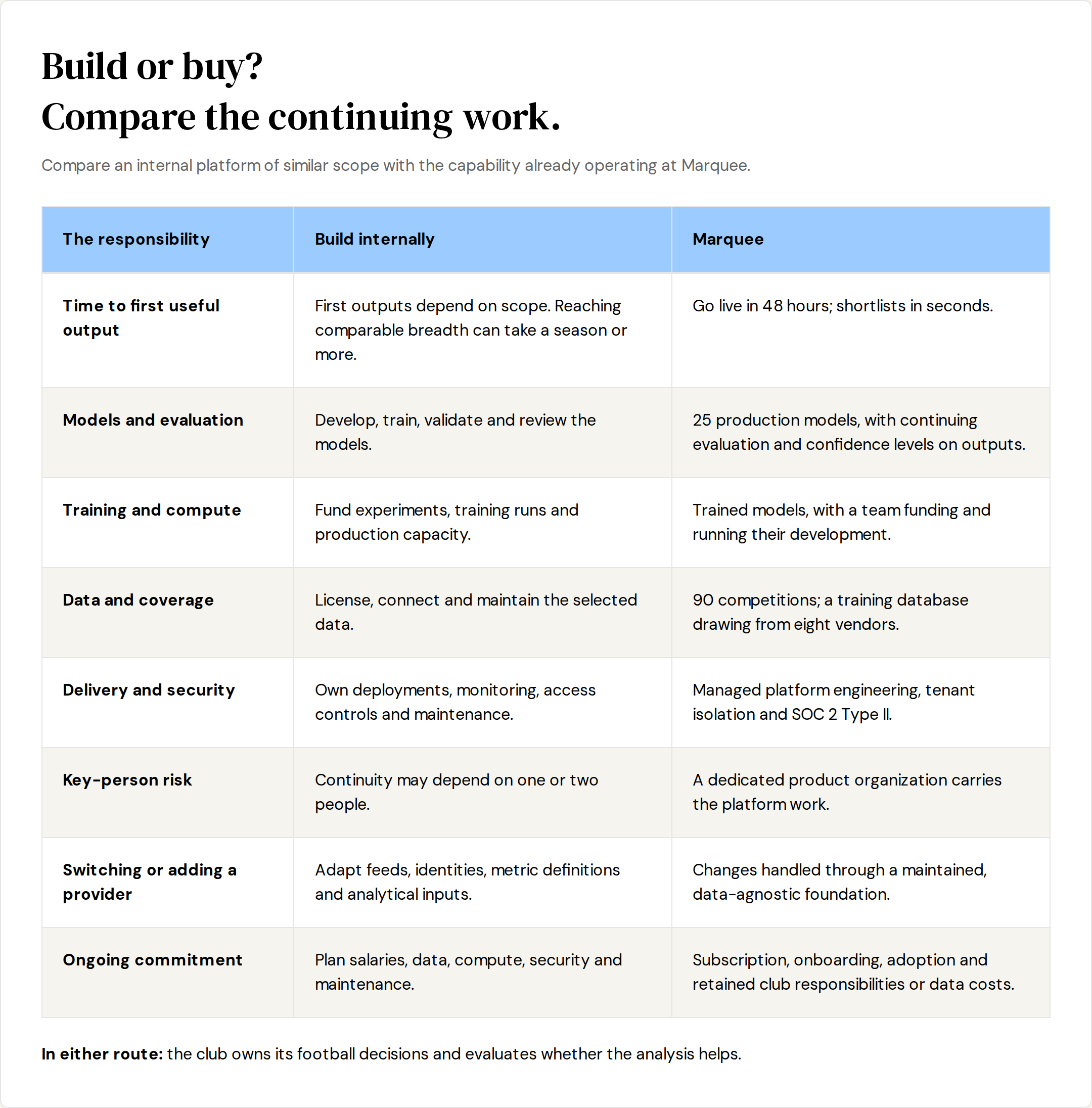
In either route, the club owns its football decisions and judges whether the analysis helps. The scope of the system and the service agreement set the exact responsibilities.
Next week there will be another match to review, another opponent to prepare for and another question worth asking. Marquee is built around that continuing work.
Bring us a football question
A recruitment brief, an upcoming opponent, a match to review or a set-piece problem. We’ll show you how Marquee approaches the work, so the build-or-buy conversation starts with something concrete.
About Marquee
Marquee turns football data into decision-ready insights in seconds, unifying external and internal data and filtering it through each club’s sporting DNA. Professional clubs use Marquee for recruitment, squad planning and analytics. Learn more at themarquee.ai.